

The “report” format of the Labo Société Numérique aims to highlight inspiring local initiatives promoting digital technology for the public good. It seeks to contribute to the spread of these initiatives and emphasize their replicability in other regions. This feature was produced by François Huguet on behalf of the Labo Société Numérique. Huguet is a researcher in digital humanities (Ph.D., Institut Polytechnique de Paris) whose work involves investigating, documenting, and promoting the digital world in the public interest.
Foreword
An impact study published by the Tarn Department—backed by statistics—confirms what digital mediators and social workers have been observing for years in the field: “digital divides” are no longer a matter of equipment, but a matter of power—the power to understand, the power to act, and the power to not feel at a loss in front of a screen. This study, which emerged from the development of the departmental roadmap for inclusive digital technology, “France Numérique Ensemble,” is enlightening—and even exemplary—in more ways than one.
A Look Back at the Process
We’d like to do away with the term. “Digital divide” sounds a bit outdated, as if the problem were simply a lack of an ADSL line or a computer that’s too old. The study conducted in the Tarn between April and June 2025, based on 205 questionnaires collected from users of twelve digital mediation centers in the department, challenges this mental framework—one that numerous studies have also been trying to dismantle for years. It does so with a level of methodological rigor unusual for this type of administrative exercise: the team behind it (notably Benoît Van Gaver, coordinator of Digital Advisors for the Tarn department, and Clémence Moliner, head of the Digital Territorial Planning department) openly acknowledges its sampling biases, draws on existing scientific literature — particularly the ANCT studies conducted by CREDOC and CREAD at the University of Rennes 2 on digital isolation — and does not hesitate to take a critical look at its own findings. This is rare enough to be worth noting, and it merits reading this study through the lens of the social sciences rather than through the more conventional framework of the “fight against the digital divide,” which seems largely irrelevant today.
PDF document
Why should this impact study be replicated?
What makes the Tarn initiative so instructive is not just its results, but its method—and that is precisely what makes it reproducible elsewhere.
A low-cost and already standardized methodology
The study does not start from scratch: it adapts the questionnaire from the national benchmark survey on the subject (Digital Mediation: What Effects on Which Audiences?, Asdo Studies for the ANCT, 2024), which was itself developed from the scientific literature based on three well-established frameworks (skills, capabilities, and the psychosocial relationship to digital technology). A department therefore does not need to design a completely new survey protocol: the framework exists, is publicly available on the “Digital Resources for the Public Good” platform, and has already been tested at the national level with over 1,300 respondents. This allows for adaptation at the local level—which the Tarn department has done with twelve partner organizations, collecting 205 usable questionnaires over three months through a combination of paper and online channels using the LimeSurvey tool, without a budget for an outsourced survey. In addition to the national survey questionnaire, which has already been made public, the ANCT will soon release an online survey tool, further facilitating local implementation and adaptation.
A decision to use subjective variables to measure the impact
Using the national survey questionnaire as a basis, the Tarn department has chosen to measure the impact of digital outreach initiatives, particularly by focusing on subjective variables related to the public’s relationship with digital technology, in order to better understand the mechanisms of the digital divide. Indeed, simply having access to equipment and possessing digital skills is not enough to understand the impact on the beneficiaries’ daily lives. The subjective dimension of the relationship with digital technology is decisive in determining whether or not uses develop that improve “agency” in daily life (see the concept of “digital capability”). The adoption of digital technologies can only occur if the individual perceives and believes in their own ability to use digital technology as a vehicle for opportunities.
A data cross-reference that changes everything
The real added value in the Tarn department is not the questionnaire itself, but its systematic cross-referencing with data already available in any department equipped with the “Digital Advisor” system: activity statistics from the Digital Mediation Cooperative (the activity tracking tool made available by the ANCT to all mediators), INSEE data on population and educational attainment, and the INSEE municipal density grid to assess rurality. It is this cross-referencing that makes it possible to identify biases (such as the underrepresentation of young people in the sample, corrected by actual activity figures) and to make the numbers speak for themselves at the sub-departmental level—without collecting a single additional data point in the field.
A rare example of methodological integrity, which should set the standard
The study documents its own blind spots rather than glossing over them: selection bias toward willing participants, the absence of experiences of exclusion, and the underrepresentation of minors and activists. This transparency is not merely cosmetic—it is what allows another region to know, before replicating the study, which groups it will need to specifically reach beyond the questionnaire alone (outreach efforts, supplementary qualitative interviews, etc.).
A format that makes the study politically actionable
By linking usage results to concrete field data—the number of digital advisor positions, changes in their budgets, the network of France Services centers—the Tarn study transforms an impact assessment exercise into an advocacy case that can be directly used with departmental elected officials and funding partners. This has helped generate momentum around their departmental roadmap, as exemplified by the organization of the first “NEC Tarn.” This is a template that any Digital Territorial Planning department could adopt to objectively demonstrate, backed by local figures, a budgetary necessity that is still too often defended today through anecdotal evidence. In short: what the Tarn is demonstrating to other departments is not just another report on digital inclusion, but a replicable, low-cost impact assessment protocol that transforms on-the-ground convictions into quantified, localized evidence.
Key Takeaways
A figure that should shift the debate
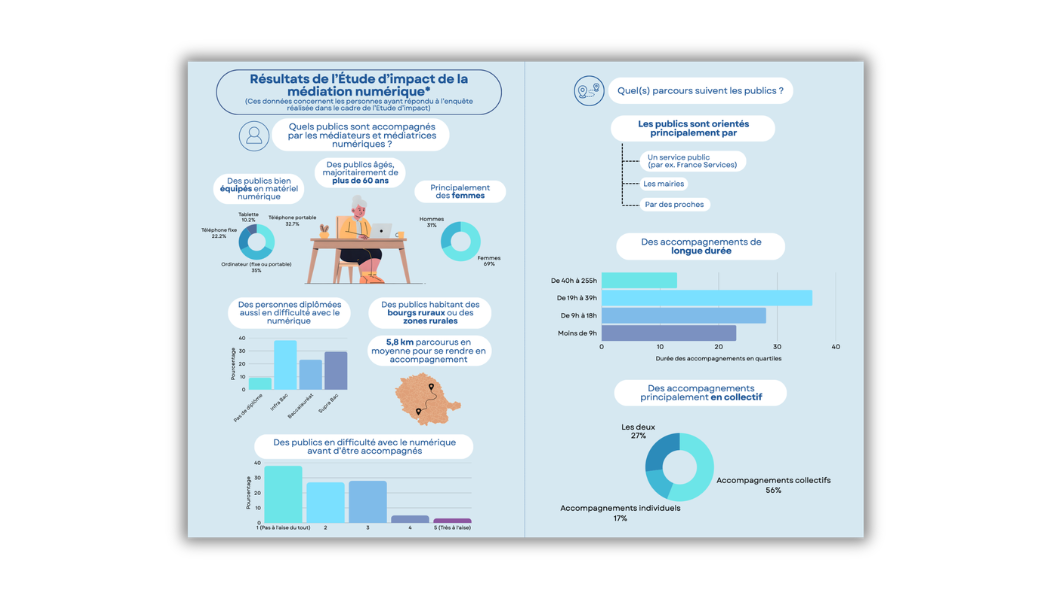
The first finding—which already challenges conventional wisdom—is that there is no shortage of devices. 87% of the people receiving support own a cell phone, 93% own a computer, and 96% have an internet connection at home—rates that are close to, and in some cases even higher than, the national average.
These figures should shift the debate. We need to move from an approach focused on what is lacking (access, equipment)—as conveyed by the concept of the “digital divide”—to an approach focused on the benefits that digital technologies bring to each person’s daily life. However, not everyone is able to benefit equally from digital technology—and that is precisely why the support provided by digital mediators is so important.
Digital Technology as a Challenge, Not a Tool
Before providing any support, the study asked participants to rate their digital proficiency on a scale of 1 to 5. The average score was 2.06—nearly two-thirds of respondents rated themselves at level 1 or 2, indicating a distinctly uncomfortable relationship with technology. But the most interesting figure isn’t that one: it’s in the explanation of the change—once the support was completed—that the true nature of the problem becomes apparent. When asked what had changed for them, 68% of participants cited, first and foremost, the fact that they were “less stressed about using digital tools,” far ahead of simply acquiring technical skills.
Drawing on theoretical insights into the sources of a sense of competence, the study shows that emotional state (68%) and personal experience gained through practice (59.8%) carry the most weight in rebuilding confidence—far more than external encouragement (23%). In other words: what digital mediation “heals,” above all, is anxiety. The online form, the account to create, the login credentials to retrieve: each of these steps, trivial for those who have mastered them, becomes a risk of exclusion for those who have not. When digital technology becomes the sole means of accessing a right, it ceases to be a tool for empowerment and becomes a mechanism for social sorting—and it is this sense of constant risk, more than technical ignorance, that mediators spend most of their time defusing.
A specific audience: age, gender, education level, occupation
The study has the merit of not stopping at an implicit universalist assumption along the lines of “this applies to everyone.” Women account for 70% of those receiving support—a figure that the study team attributes both to the social division of labor in household management and to a greater, socially constructed propensity to seek help rather than resort to coping on their own.
Educational attainment, for its part, serves as an indicator: 38% of those receiving support do not have a high school diploma. The study takes care to specify that this criterion serves as an indicator of cultural capital rather than social background in the strict sense—since the expansion of higher education has led, even among lower-income groups, to disparities in educational attainment that no longer exactly correspond to income disparities. In this regard, recent research shows that educational attainment is the most significant factor in determining the population’s relationship to digital technology.
What is also striking is the extent to which this audience is aging: 86.3% of those receiving support are over 60, and more than half—52.6%—are over 70. This is therefore not a population that is merely “a little older than average”: it is a population composed almost exclusively of the very elderly, with virtually no representation from any other segment of the working-age population (0.5% for those aged 25–39, even though they make up 15% of the Tarn’s population). Several factors can explain this overrepresentation. On the one hand, from a practical standpoint, this group is characterized by high availability, which is often compatible with the schedules offered for support services. On the other hand, it is among the 70-and-over age group that we find the largest proportion of people without a high school diploma—a group that did not experience the expansion of mass education and for whom digital tools entered their lives relatively late.
But it is the analysis by socio-professional category that reveals the most striking—and least frequently discussed—surprise in this type of report: farmers are four times more likely to be among those receiving support (8%) than in the Tarn population as a whole (2%). Employees are also overrepresented (36% versus 25% in the general population). This is no coincidence. First, these are groups that are highly concentrated in the Tarn region and, once again, tend to include individuals with little or no formal education. Furthermore, it should be noted that these groups are particularly exposed to complex, paperless administrative requirements—such as online CAP and MSA filings—and seek assistance in a context where digital mediators serve as easily accessible intermediaries. Digital mediation, in this context, is not merely a matter of age: it also intersects with a very concrete professional landscape rooted in the local context.
Territory: Not Distance, but the Network
In this predominantly rural department, one might have expected geographic distance to be the number one factor. That is not what the study shows: 61% of clients are assisted in their own municipality of residence, with an average distance traveled of 5.8 km and an average travel time of +/- 7 minutes. The real challenge, therefore, is not the distance in kilometers, but the density of the network—the ability of the network of mediators, who are often mobile, to integrate into residents’ daily lives without requiring them to make a special trip to complete a procedure. This network relies in large part on close coordination with France Services centers: in the Tarn department, seven departmental digital advisors work directly with ten France Services centers, which serve as local administrative support hubs capable of identifying digital assistance needs that require the intervention of digital mediators. This helps bridge the gap from administrative autonomy to digital autonomy.
There is one statistic worth noting: only 45% of those receiving support say they can count on a family member or friend to get help with digital technology when needed. In other words, for the majority of them, the digital mediator is not just one option among many—it is the only one. This figure sheds new light on the concept of “digital mediation as a social connection”: it is not just a nice-to-have; it is sometimes the only safety net…
The Blind Spot: The Need for Administrative Support
When it comes to online administrative procedures, digital advisors are not intended to take over the responsibilities of France Services agents beyond providing initial “assistance,” and must therefore direct users to the nearest France Services location. On paper, the distinction is clear: digital assistance on one hand, administrative assistance on the other.
In the Tarn region, as in many other parts of France, this distinction is becoming increasingly blurred. Online administrative procedures remain one of the most frequently discussed topics in support services. For some of these individuals, the challenge is therefore not—or not solely—digital: it is first and foremost a matter of administrative mediation, which professionals who are not trained for this purpose—and are not authorized to do so—sometimes find themselves having to handle. Indeed, providing digital support to the public can facilitate access to online administrative procedures, but the difficulties experienced by French citizens in completing these procedures are primarily administrative in nature. While the digitization of administrative procedures has simplified the process for some people, it creates a direct relationship with the government (without a human intermediary) that poses difficulties for nearly 1 in 2 French people. The need for human intermediation is thus shifted toward digital mediators or social workers, who find themselves grappling with a professional dilemma embodied by the gap between what they believe they should do and what they actually do.
What Mediation Changes: Assessing Our Relationship with Digital Technology
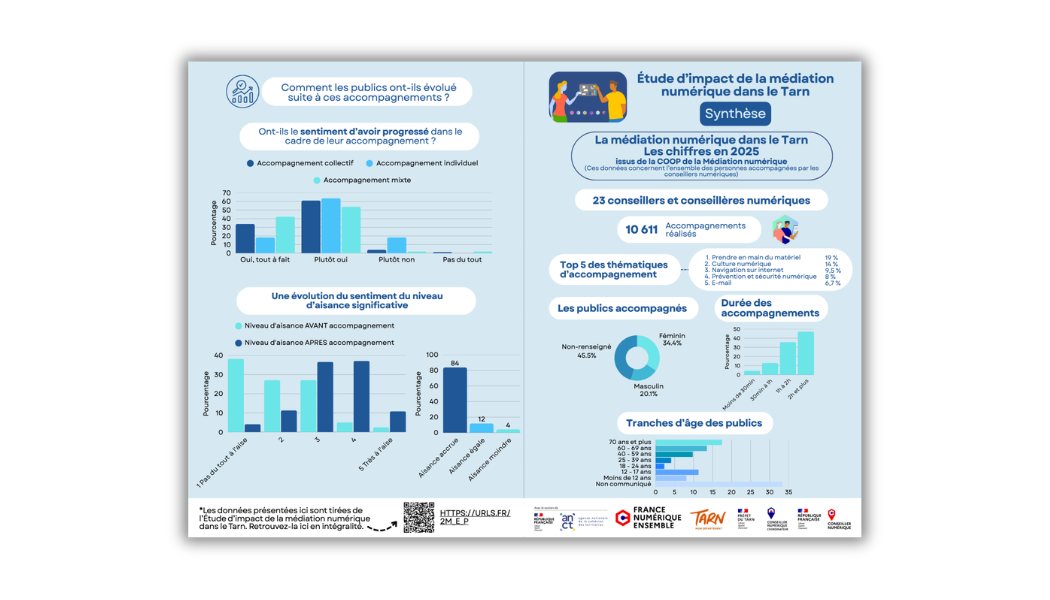
Perhaps the strength of this study lies not so much in counting the number of support sessions as in seeking to measure their impact. To do this, the study goes beyond simply asking participants if they are satisfied: it examines their relationship with digital technology before and after the support, using a series of questions designed to capture subjective changes—such as their sense of comfort, confidence, stress, or sense of progress. The issue of comfort is particularly illuminating in this regard. Before receiving support, respondents rated their digital comfort at an average of 2.06 out of 5. After the program, this average rose to 3.39 out of 5. This shift does not merely indicate that participants learned how to perform specific tasks; it suggests that they feel more capable of navigating the digital world.
This is also reflected in the responses to questions about the perceived effects of the support. 68% of respondents report feeling less stressed about using digital tools, while 59.8% cite the experience gained through practice as a factor that contributed to their sense of competence. External encouragement, on the other hand, is mentioned by only 23%. In other words, the support program seems to achieve something that goes beyond the mere transfer of technical skills: it helps people regain control over situations they previously found difficult or even anxiety-inducing. The questionnaire thus raises a series of simple yet politically significant questions: Do I feel more comfortable than before? Am I less afraid of making a mistake? Do I feel more capable of solving a problem on my own? Do I feel more confident using a digital tool or following a digital process? Do I feel like I’ve made progress?
By shifting from a measurement of skills to a measurement of one’s relationship with digital technology, the study reveals an often-overlooked aspect of mediation: the restoration of the ability to act.
The results are particularly clear on this point: 94% of participants feel they have made progress, and 98% say they are satisfied with the support they received. Of course, these figures alone do not constitute proof of a lasting change in practices—the study, in fact, acknowledges the inherent limitations of a survey conducted among people who have already sought help. But they highlight something that activity indicators alone cannot reveal: what changes during the support process is not just what people know how to do, but how capable they feel of using digital technology. This is likely one of the main benefits of this method.
Measuring the impact of digital mediation isn’t just about counting the number of support sessions; it’s about being able to compare a baseline condition with a post-support condition, thereby highlighting a transformation. Comfort, stress, confidence, and a sense of competence or progress thus become indicators of a public policy that addresses a dimension that is otherwise difficult to quantify: the relationship individuals have with a digital environment that has become indispensable.
What the study itself does not hide
We must give this study its due: unlike many institutional reports, the Tarn study devotes a significant portion of its conclusion to what it does not see. It states this plainly: the people surveyed here are not the most vulnerable. These are people who had the resources—material, cognitive, and social—to reach out to a mediator, to understand that they had a gap in their knowledge, and to find a way to fill it. Left off the radar of this survey—as well as many others—are those who lack access to affordable technology, who do not recognize their own gaps, or who experience digital exclusion as a result of circumstances rather than by choice—precisely the groups the hardest to reach, because they must first be identified before they can be referred to appropriate services.
The study also implicitly highlights the fragility of the “digital natives” myth: young people under 18—who were virtually absent from the sample for methodological reasons—nevertheless account for a significant portion of the work handled by the department’s digital advisors (7.4% for those under 12, 10.8% for 12- to 17-year-olds, according to activity data), with support focused on other issues—social media, cyberbullying, misinformation—that have nothing to do with a supposed innate mastery of digital tools by young people.
A Public Policy for a Social Phenomenon
The Tarn study rightly concludes that digital mediation should be viewed as a sustainable social infrastructure rather than as a temporary measure intended to “catch up.” Indeed, digital mediation, like other forms of mediation related to lifelong adult education, has strong ties to popular education, which focuses on civic and social education. The confident mastery of digital technology fostered by digital mediation goes hand in hand with the development of a digital culture that enables people to develop a discerning perspective on digital practices.
Thus, digital mediation helps reduce the public’s exposure to the risks that digital technology can pose (online misinformation, cybercrime, screen addiction, etc.), while enabling them to benefit from these technologies in their daily lives. Taken together, the fight against the digital divide and the promotion of informed use of digital technologies make digital mediation the cornerstone of a harmonious digital society.
Throughout France, the work of digital mediators—which is based on close, personal relationships—forms the foundation of an ambitious digital inclusion policy that fosters social ties and territorial cohesion.