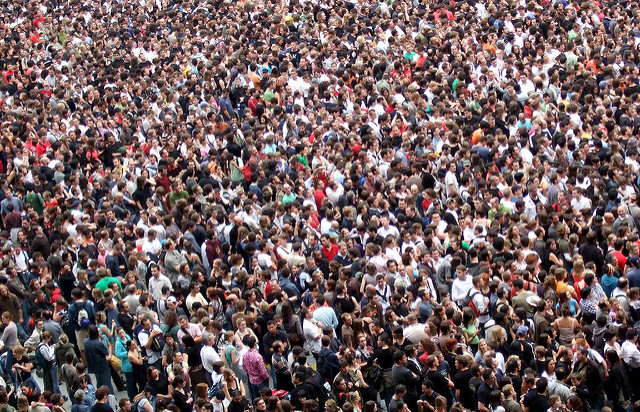
Contributory practices, participatory production, citizen crowdsourcing, the intervention of the "multitude" in the production of information and knowledge are probably one of the major transformations that digital technology has produced.
Beyond the "digital cathedrals" that are Wikipedia or OpenStreetMap, there is a wide variety of projects, platforms and applications that rely on the contribution of people: participatory science, collaborative indexing in the world of libraries and archives, reporting problems on the public highway ....
To what extent are the French involved in participatory production practices?
Major surveys such as the Digital Barometer or Capacity give a fairly rough measure of these contributory practices, through questions such as "are you more of a reader, on discussion forums, social networks, chats, blogs, a contributor or both?" Thus, according to the Capacity survey, 2.5% of Internet users described themselves in 2016 as " contributors on discussion forums, social networks, chats, blogs", 44% as "readers of what others say or write" and 19% as "both".
Nearly 114,000 contributors in France to Wikipedia
The Wikipedia encyclopedia was created in 2001. With a very active French community but also Swiss, Belgian, Canadian or African, the French edition has 2,146,013 pages in October 2019. It records 700 million views per month (687 million in December 2018), or 23.3 million per day, including 16 million from France (68.5%).The French edition of Wikipedia had 3.5 million registered users in October.
Of these, 18261 have taken at least one action (edition or correction) in the last 30 days.
The French are at the origin of 82% of the writing operations ("edits") on the French edition while contributing to the other editions.
In December 2018, the French edition of Wikipedia had 138,924 contributors (registered users in the world had edited at least ten times since their arrival) of which 82% were French, or about 114,000.
Nearly 90,000 French people involved in 2018 in participatory science operations related to biodiversity
In 2018, several tens of thousands of people participated in a participatory science program in France.
Of these, 89,275 took part in biodiversity-related participatory science operations, an increase of 16% over 2018 and 342% since 2011.
The indicator relating to "" records the number of active participants in participatory science programs. This indicator meets one of the objectives set by the National Strategy for Biodiversity in 2011, namely to involve citizens in biodiversity conservation. Participatory science
The indicator relating to "" records the number of active participants in participatory science programs. This indicator meets one of the objectives set by the National Strategy for Biodiversity in 2011, namely to involve citizens in biodiversity conservation. Participatory science
"Thanks to this community of volunteer observers, the thousands of data collected have been posted on dedicated websites, verified and analyzed by scientists or experts from the Natural History Museum, the CNRS, the Office for Insects and their Environment, Tela Botanica... This data feeds studies on the evolution of biodiversity and allows the production of information and awareness documents.
Référence :
These communities that rely on Openstreetmap and participatory mapping
A certain number of local authorities propose that citizens contribute to the knowledge of their territory: a way of co-constructing the territory with the inhabitants and sometimes also of compensating for the erosion of budget resources. They rely, in particular, on . In addition to traditional information such as traffic routes, buildings or water surfaces, users can incorporate data such as bicycle paths, glass containers, public toilets or drinking water points into this collaborative map. Some communities (such as the Caux Vallée de Seine community or the Allier department) even organize workshops, based on the model of the carto-parties organized by OpenstreetMap communities, to gather a maximum amount of information on a given territory over a short period of time.OpenStreetMap
Île-de-France Mobilités (formerly STIF, Syndicat des transports d'Île-de-France) has in 2017 to involve the people of Ile-de-France in the inventory of cycling facilities throughout the region. The most exhaustive knowledge possible (and of good quality) of these facilities and their updating aim to develop tools for route calculations while contributing to local policies in favor of cycling. In addition to local authorities, urban planning and development agencies and local bicycle stakeholders (such as the association Mieux se Déplacer à Bicyclette), this project relies on the OpenstreetMap community. It also relies on the contribution of people who can report directly in OpenstreetMap or via a , the various existing cycling facilities: cycle track, cycle lane, two-way cycle lane, bus lane open to bikes, parking lots. The Compagnie des Mobilités, together with Carto'Cité and the association Mieux se Déplacer à Bicyclette, is leading this campaign (a similar initiative was conducted in Lyon, but this time by an association).undertakendedicated portalThe City by Bike
Références :
Applications for reporting urban problems: a use that comes up against the fragmentation of platforms in France
Many cities around the world allow citizens to report a wide variety of problems or incidents from their mobile devices: road, sidewalk, tree and garden maintenance, graffiti, bulky objects and abandoned vehicles, connectivity, faulty traffic lights and street lighting, dangerous intersections, potholes... After identifying a problem, the user selects the type of incident in the application, possibly specifying the nature or importance of the problem, takes a photo that the GPS will geolocate to complete the description and automatically transmits to the relevant department. The processing chain, dematerialized from end to end, allows the city services concerned (mainly the road department) to have a global view of incidents and to plan their interventions.FixMyStreetIn the United Kingdom, the City of London is a pioneer in this field. Launched in 2007 by the mySociety Foundation, it has grown significantly with the deployment of a mobile application. It records 6,205 reports per week: over millions of reports since its inception. More than two million reports have been made over the past 10 years, primarily in the categories of littering, street lighting, street and road conditions and potholes. However, the resolution rate is only 40% with an average processing time of almost 3 months.Similar platforms have emerged in the United States(SeeClickFix, Citysourced or PublicStuff, each of which lists several hundred American cities) or in the Netherlands with BuitenBeter
Several platforms (Tellmycity, Allô Mairie, Fixmaville, Keyclic, BetterStreet, Beecitiz, etc.) have emerged in France since 2010.
In a recent study recent study, which aims to understand how to involve citizens and civil society in the design and delivery of public services, the interministerial directorate for public transformation (DITP) looks at the case of applications for reporting urban problems, among a dozen initiatives involving citizens and public services.
Unlike FixMyStreet, their equivalents in France "are experiencing difficulties in generalizing to the whole territory: limited adoption by civil society, competitive landscape with a large number of players".
Références :
Collaborative indexing: when cultural institutions call on the public to annotate works, documents and archives
The campaign to index the records of the soldiers of World War I and its success (1.4 million indexed records) have given visibility to the various forms of "cultural crowdsourcing" deployed by museums, archives and libraries.Many institutions now offer the public the opportunity to annotate, correct or complete digitized resources, and to take part, through their contributions, in the enhancement of collections as well as in the knowledge of heritage.
These practices of "crowd sourcing" can take various forms: nominative survey of genealogical sources, indexing of files, identification of photographs, correction of errors in digitized documents ...
A large number of departmental archives now offer collaborative indexing modules that allow those who consult digitized archives (usually parish and civil registers, sometimes censuses and matriculation registers) to annotate them.
As part of the Grand Mémorial program, the archives of several departments are offering citizens the opportunity to index the registers of each of the 8.5 million combatants of the First World War.
The National Archives, for their part, opened a collaborative platform in early 2018 where citizen volunteers can transcribe wills written by Poilus during World War I. The "Testaments de Poilus" project aims to produce an electronic edition of a thousand wills of the Poilus of the First World War. The documents studied come from the notary archives of the Yvelines Departmental Archives.
In order to promote the indexing and analysis work carried out by Internet users and volunteers on the basis of archival collections, the National Archives have opened the blog Archives nationales participatives. Among the projects proposed to Internet users is the indexation of the registers of the Conseil général des ponts et chaussées. The Natnum database of digitized naturalization decrees will gradually be opened to collaborative indexing.
Références :
Openstreetmap and FixMystreet: gender disparities and biases in contributory practices
There are now many works devoted to gender relations, or attentive to this perspective.The overrepresentation of men on platforms such as Wikipedia (90%) or OpenstreetMap (95%) is now the subject of studies that attempt to identify the effects of this overrepresentation on the nature of contributions.
Only 18% of Wikipedia biographies are dedicated to women. For several years, a number of initiatives have been aimed at highlighting women, such as the group Without Pages group, which aims to create and improve Wikipedia articles about women, feminism, and other underrepresented topics. For several years, " edit-a-thons For several years now, "Women's Wikipedia" events have been held in various countries to encourage women to edit Wikipedia, to increase coverage of certain topics, and also to create pages for women who lack coverage. One researcher, Jess Wade, has undertaken to create several hundred biographies of women scientists.
Gender bias in OpenstreetMap
The overrepresentation of men among contributors to the collaborative map (95%) translates into biases in the types of locations that are labeled. According to Rachel Levine, Mapping Operations Coordinator at the American Red Cross, " stadium locations, strip clubs, and bars are much better documented than child care centers or women's health clinics are vastly underrepresented. 800,000 physician offices are labeled but only 10 abortion care facilities and only one domestic violence center."Sources
- 1. A portal for participatory science
- 2. For a better knowledge of cycling facilities in Île-de-France
- 3. City of Lannion, Côtes d'Armor: Using OpenStreetMap for public services
- 4. The Allier launches into participatory geographic data collection
- 5. Lorient Agglomeration: a route planner for people with reduced mobility
- 6. Map of the Seignanx territory
- 7. Maine-et-Loire finds an open source alternative to Google Maps
- 8. Google Maps price hike: "We need free alternatives more than ever
- 9. Gilles Palsky : participative cartography, undisciplined cartography
- 10. Interministerial Directorate for Public Transformation (DITP) Citizens as actors in public service: what initiatives to involve them more?
- 11. IDDRI (Institute for Sustainable Development and International Relations): urban crowdsourcing and digital citizen participation
- 12. Apps and platforms for reporting incidents and problems on the public highway
- 13. I
- 14. Collaborative indexing: when cultural institutions call on the public to annotate works, documents and archives

Some indicators of the contribution practices of the French
Contributory practices, participatory production, citizen crowdsourcing, the intervention of the "multitude" in the production of information and knowledge are probably one of the major transformations that digital technology has produced.
Beyond the "digital cathedrals" that are Wikipedia or OpenStreetMap, there is a wide variety of projects, platforms and applications that rely on the contribution of people: participatory science, collaborative indexing in the world of libraries and archives, reporting problems on the public highway ....
To what extent are the French involved in participatory production practices?
Major surveys such as the Digital Barometer or Capacity give a fairly rough measure of these contributory practices, through questions such as "are you more of a reader, on discussion forums, social networks, chats, blogs, a contributor or both?" Thus, according to the Capacity survey, 2.5% of Internet users described themselves in 2016 as " contributors on discussion forums, social networks, chats, blogs", 44% as "readers of what others say or write" and 19% as "both".
Nearly 114,000 contributors in France to Wikipedia
The Wikipedia encyclopedia was created in 2001. With a very active French community but also Swiss, Belgian, Canadian or African, the French edition has 2,146,013 pages in October 2019. It records 700 million views per month (687 million in December 2018), or 23.3 million per day, including 16 million from France (68.5%).The French edition of Wikipedia had 3.5 million registered users in October.
Of these, 18261 have taken at least one action (edition or correction) in the last 30 days.
The French are at the origin of 82% of the writing operations ("edits") on the French edition while contributing to the other editions.
In December 2018, the French edition of Wikipedia had 138,924 contributors (registered users in the world had edited at least ten times since their arrival) of which 82% were French, or about 114,000.
Nearly 90,000 French people involved in 2018 in participatory science operations related to biodiversity
In 2018, several tens of thousands of people participated in a participatory science program in France.
Of these, 89,275 took part in biodiversity-related participatory science operations, an increase of 16% over 2018 and 342% since 2011.
The indicator relating to "" records the number of active participants in participatory science programs. This indicator meets one of the objectives set by the National Strategy for Biodiversity in 2011, namely to involve citizens in biodiversity conservation. Participatory science
The indicator relating to "" records the number of active participants in participatory science programs. This indicator meets one of the objectives set by the National Strategy for Biodiversity in 2011, namely to involve citizens in biodiversity conservation. Participatory science
"Thanks to this community of volunteer observers, the thousands of data collected have been posted on dedicated websites, verified and analyzed by scientists or experts from the Natural History Museum, the CNRS, the Office for Insects and their Environment, Tela Botanica... This data feeds studies on the evolution of biodiversity and allows the production of information and awareness documents.
Référence :
These communities that rely on Openstreetmap and participatory mapping
A certain number of local authorities propose that citizens contribute to the knowledge of their territory: a way of co-constructing the territory with the inhabitants and sometimes also of compensating for the erosion of budget resources. They rely, in particular, on . In addition to traditional information such as traffic routes, buildings or water surfaces, users can incorporate data such as bicycle paths, glass containers, public toilets or drinking water points into this collaborative map. Some communities (such as the Caux Vallée de Seine community or the Allier department) even organize workshops, based on the model of the carto-parties organized by OpenstreetMap communities, to gather a maximum amount of information on a given territory over a short period of time.OpenStreetMap
Île-de-France Mobilités (formerly STIF, Syndicat des transports d'Île-de-France) has in 2017 to involve the people of Ile-de-France in the inventory of cycling facilities throughout the region. The most exhaustive knowledge possible (and of good quality) of these facilities and their updating aim to develop tools for route calculations while contributing to local policies in favor of cycling. In addition to local authorities, urban planning and development agencies and local bicycle stakeholders (such as the association Mieux se Déplacer à Bicyclette), this project relies on the OpenstreetMap community. It also relies on the contribution of people who can report directly in OpenstreetMap or via a , the various existing cycling facilities: cycle track, cycle lane, two-way cycle lane, bus lane open to bikes, parking lots. The Compagnie des Mobilités, together with Carto'Cité and the association Mieux se Déplacer à Bicyclette, is leading this campaign (a similar initiative was conducted in Lyon, but this time by an association).undertakendedicated portalThe City by Bike
Références :
Applications for reporting urban problems: a use that comes up against the fragmentation of platforms in France
Many cities around the world allow citizens to report a wide variety of problems or incidents from their mobile devices: road, sidewalk, tree and garden maintenance, graffiti, bulky objects and abandoned vehicles, connectivity, faulty traffic lights and street lighting, dangerous intersections, potholes... After identifying a problem, the user selects the type of incident in the application, possibly specifying the nature or importance of the problem, takes a photo that the GPS will geolocate to complete the description and automatically transmits to the relevant department. The processing chain, dematerialized from end to end, allows the city services concerned (mainly the road department) to have a global view of incidents and to plan their interventions.FixMyStreetIn the United Kingdom, the City of London is a pioneer in this field. Launched in 2007 by the mySociety Foundation, it has grown significantly with the deployment of a mobile application. It records 6,205 reports per week: over millions of reports since its inception. More than two million reports have been made over the past 10 years, primarily in the categories of littering, street lighting, street and road conditions and potholes. However, the resolution rate is only 40% with an average processing time of almost 3 months.Similar platforms have emerged in the United States(SeeClickFix, Citysourced or PublicStuff, each of which lists several hundred American cities) or in the Netherlands with BuitenBeter
Several platforms (Tellmycity, Allô Mairie, Fixmaville, Keyclic, BetterStreet, Beecitiz, etc.) have emerged in France since 2010.
In a recent study recent study, which aims to understand how to involve citizens and civil society in the design and delivery of public services, the interministerial directorate for public transformation (DITP) looks at the case of applications for reporting urban problems, among a dozen initiatives involving citizens and public services.
Unlike FixMyStreet, their equivalents in France "are experiencing difficulties in generalizing to the whole territory: limited adoption by civil society, competitive landscape with a large number of players".
Références :
Collaborative indexing: when cultural institutions call on the public to annotate works, documents and archives
The campaign to index the records of the soldiers of World War I and its success (1.4 million indexed records) have given visibility to the various forms of "cultural crowdsourcing" deployed by museums, archives and libraries.Many institutions now offer the public the opportunity to annotate, correct or complete digitized resources, and to take part, through their contributions, in the enhancement of collections as well as in the knowledge of heritage.
These practices of "crowd sourcing" can take various forms: nominative survey of genealogical sources, indexing of files, identification of photographs, correction of errors in digitized documents ...
A large number of departmental archives now offer collaborative indexing modules that allow those who consult digitized archives (usually parish and civil registers, sometimes censuses and matriculation registers) to annotate them.
As part of the Grand Mémorial program, the archives of several departments are offering citizens the opportunity to index the registers of each of the 8.5 million combatants of the First World War.
The National Archives, for their part, opened a collaborative platform in early 2018 where citizen volunteers can transcribe wills written by Poilus during World War I. The "Testaments de Poilus" project aims to produce an electronic edition of a thousand wills of the Poilus of the First World War. The documents studied come from the notary archives of the Yvelines Departmental Archives.
In order to promote the indexing and analysis work carried out by Internet users and volunteers on the basis of archival collections, the National Archives have opened the blog Archives nationales participatives. Among the projects proposed to Internet users is the indexation of the registers of the Conseil général des ponts et chaussées. The Natnum database of digitized naturalization decrees will gradually be opened to collaborative indexing.
Références :
Openstreetmap and FixMystreet: gender disparities and biases in contributory practices
There are now many works devoted to gender relations, or attentive to this perspective.The overrepresentation of men on platforms such as Wikipedia (90%) or OpenstreetMap (95%) is now the subject of studies that attempt to identify the effects of this overrepresentation on the nature of contributions.
Only 18% of Wikipedia biographies are dedicated to women. For several years, a number of initiatives have been aimed at highlighting women, such as the group Without Pages group, which aims to create and improve Wikipedia articles about women, feminism, and other underrepresented topics. For several years, " edit-a-thons For several years now, "Women's Wikipedia" events have been held in various countries to encourage women to edit Wikipedia, to increase coverage of certain topics, and also to create pages for women who lack coverage. One researcher, Jess Wade, has undertaken to create several hundred biographies of women scientists.
Gender bias in OpenstreetMap
The overrepresentation of men among contributors to the collaborative map (95%) translates into biases in the types of locations that are labeled. According to Rachel Levine, Mapping Operations Coordinator at the American Red Cross, " stadium locations, strip clubs, and bars are much better documented than child care centers or women's health clinics are vastly underrepresented. 800,000 physician offices are labeled but only 10 abortion care facilities and only one domestic violence center."Sources
- 1. A portal for participatory science
- 2. For a better knowledge of cycling facilities in Île-de-France
- 3. City of Lannion, Côtes d'Armor: Using OpenStreetMap for public services
- 4. The Allier launches into participatory geographic data collection
- 5. Lorient Agglomeration: a route planner for people with reduced mobility
- 6. Map of the Seignanx territory
- 7. Maine-et-Loire finds an open source alternative to Google Maps
- 8. Google Maps price hike: "We need free alternatives more than ever
- 9. Gilles Palsky : participative cartography, undisciplined cartography
- 10. Interministerial Directorate for Public Transformation (DITP) Citizens as actors in public service: what initiatives to involve them more?
- 11. IDDRI (Institute for Sustainable Development and International Relations): urban crowdsourcing and digital citizen participation
- 12. Apps and platforms for reporting incidents and problems on the public highway
- 13. I
- 14. Collaborative indexing: when cultural institutions call on the public to annotate works, documents and archives
Labo Société Numérique