


Presented at the CHI 2026 international conference, the paper “How Interface Design Choices Lead to Indirect Environmental Impacts Through Use Intensification,” authored by French researchers Anaëlle Beignon (University of Strasbourg), Aurélien Tabard (Claude Bernard University of Lyon 1), and Nolwenn Maudet (University of Strasbourg), proposes a shift in perspective on the environmental impacts of digital technology. Moving beyond a strictly technical interpretation of environmental impacts, this article explores how design choices contribute, in subtle yet decisive ways, to the intensification of digital usage and its ecological consequences.
Référence :
The Cornucopian Paradigm
The scope of the analysis:
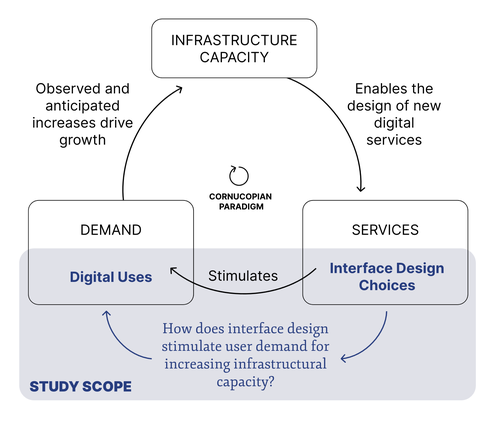
Drawing on an empirical study of instant messaging apps (WhatsApp, Instagram, Messenger, Telegram, Snapchat, etc.), the authors of this article demonstrate that design choices do more than simply shape the user experience. They actively contribute to transforming practices by steering usage toward increasingly intensive forms. This intensification thus emerges as a central link connecting design to environmental impacts. The theoretical framework employed falls within the so-called “Cornucopian” paradigm—or “horn of plenty” paradigm—which is well known in human-computer interaction. This paradigm describes a circular dynamic in which the growth of digital services stimulates demand, which in turn justifies the expansion of infrastructure, thereby enabling the emergence of new services. It is a self-reinforcing system in which increased usage and technical expansion feed into one another.
From this perspective, technologies do not simply meet preexisting needs; they help create them and reinforce their uses. The authors draw here on concepts similar to rebound effects or induced demand, but focus more specifically on the concrete mechanisms at work in interface design. This is because interfaces are not neutral: they shape possibilities, prioritize actions, and establish norms of use.
Référence :
A Qualitative Methodology
The study is based on a qualitative methodology that combines an analysis of 110 features from 17 messaging apps, an examination of affordances through a “technical walkthrough” (see Reference 3 below), and twelve semi-structured interviews with users. Taken together, these findings highlight a cross-cutting phenomenon: the intensification of digital usage.
This intensification is reflected in a simultaneous increase in the volume of data exchanged, the frequency and duration of interactions, and the computational complexity of practices (the level of computing resources required to carry out a given digital activity: all the calculations, data processing, and technical operations necessary for an activity to function—whether or not they are visible to the user). It constitutes the mediating mechanism through which design contributes, indirectly, to the increase in the environmental footprint. Several design “patterns” or “schemes” appear to be particularly influential in this process (a pattern/scheme corresponds to a typical design choice—for example, a push notification, an infinite scroll, or a text-entry indicator—that shapes the user experience and guides usage). The increase in communication capabilities—particularly the ability to send large files— the diversification of communication formats, the growing integration of artificial intelligence features, the hybridization with social media logic, and the continuous accumulation of data all contribute to reinforcing this dynamic of intensification. All of these design choices concretely embody the principles of the Cornucopian paradigm.
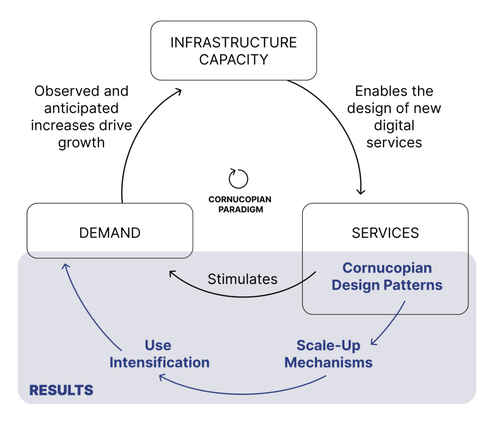
Features that are becoming increasingly resource-intensive
Beyond these technical characteristics, the study highlights intertwined socio-technical mechanisms. For example, interfaces encourage the adoption of more resource-intensive features, while reinforcing dependence on platforms through powerful network effects. At the same time, hardware requirements are increasing, contributing to the accelerated obsolescence of devices. Finally, intensive usage is gradually becoming the norm, embedding expectations of immediacy and constant availability into social practices.
These findings call for a reconsideration of the idea of an autonomous “user demand.” Far from being simply expressed by individuals, this demand appears to be largely co-produced by design and social dynamics. Interface design thus emerges as a central driver of digital growth, making increasingly intensive uses both desirable and invisible, while normalizing the idea of a digital world without limits.
Contributions and Limitations
Another major contribution of this study lies in its multilevel approach, which integrates individual practices, social interactions, and technical infrastructure. This perspective goes beyond strictly technical or behavioral analyses by situating usage patterns within broader socio-technical dynamics.
However, certain limitations are highlighted, including the focus on messaging apps, the lack of precise quantification of the observed effects, and the rapid evolution of technologies—particularly those related to artificial intelligence—which could reshape these dynamics.
By highlighting the fundamental role of design in driving increased usage, this research opens up important avenues for thinking about digital sustainability. In particular, it calls for the development of evaluation methods that account for indirect effects, the design of interfaces that promote more frugal usage, and a critical examination of the economic models that underpin design choices.
More broadly, it contributes to a critical examination of the conditions necessary for a truly sustainable form of digital design—one capable of breaking away from the logic of intensification that, according to the authors, characterizes today’s digital economy.
Référence :
Sources
1. Conference on Human Factors in Computing Systems—one of the leading international scientific events in the field of human-computer interaction, the social uses of digital technology, and the societal, cultural, and environmental impacts of technology.
2. The rebound effect refers to a phenomenon in which the efficiency gains of a technology—for example, a reduction in energy consumption per unit of use—paradoxically lead to an overall increase in consumption. This increase can be attributed to changes in behavior (more frequent use, expansion of uses) or to economic factors (lower costs, increased demand).
Induced demand refers to the process by which an increase in supply or technical capacity generates new uses and needs that did not exist before. In other words, infrastructure and technology do not merely respond to preexisting demand; they help create it by making new practices possible, accessible, or desirable.
3. The term “affordance,” which originates from ecological psychology, refers to the possibilities for action that an environment or object offers an individual, based on its properties and the individual’s capabilities. In the fields of digital technology and interface design, an affordance corresponds to what an interface “suggests” or makes possible for the user to do. For example, a visually prominent button invites the user to click it, a text field invites the user to type, and a notification invites the user to view it. Affordances are not merely technical; they are also perceived and interpreted. They guide behavior by making certain actions more visible, easier, or more legitimate than others, thereby helping to shape usage patterns.